
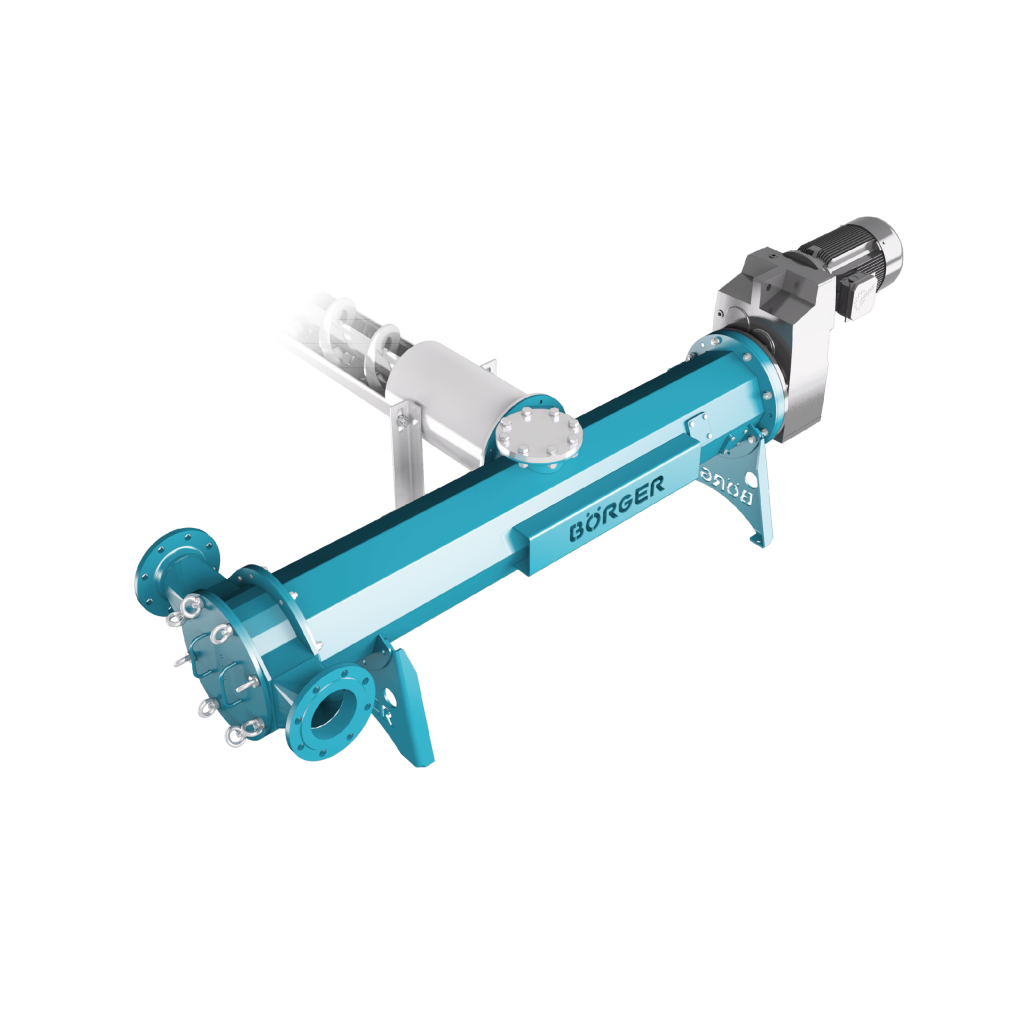
The best solution — the Börger Powerfeed unit
Powerfeed renewable-feedstock technology guarantees the safe, reliable delivery of solids into closed flow pipeline systems.
Powerfeed is available in two sizes. The Powerfeed 300 delivers about 4–5 t/h at very low speeds to minimise wear, while the Powerfeed 400 can reach up to 9 t/h. A higher feed rate can be achieved by increasing the speed.
Integrating a Powerfeed unit into a biogas plant
Powerfeed technology and a powerful biogas pump form the heart of a mobile feeding system. On both the suction and discharge sides, all tanks are connected to the pump through a manifold block with adjustable valves. The Powerfeed mechanical feeding equipment is installed in the discharge pipeline. In a fully closed system, Börger's dosing equipment feeds the substrate into the flow pipeline. The relevant knife gate valves direct the substrate to the required digester.
How the Powerfeed feeding unit works
Biomass is fed in through the hopper. The Powerfeed screw shaft conveys the organic material, breaking it up and compressing it towards the press channel. The press channel leads to a flushing unit connected to the feed pipeline. The plugs formed in the press channel act as a self-renewing seal. The feedstock is broken up by the position and type of press in the Powerfeed and by the design of the blades and the dosing device. As a result it gains a large surface area while releasing the air entrained during the process.
At the same time the organic material is metered into the liquid flow (recirculated) and forms noticeably fewer floating layers. Appropriate settings of the downstream diverter allow the mixture of solids and liquid to flow in the required direction to the required tank.
Powerfeed components
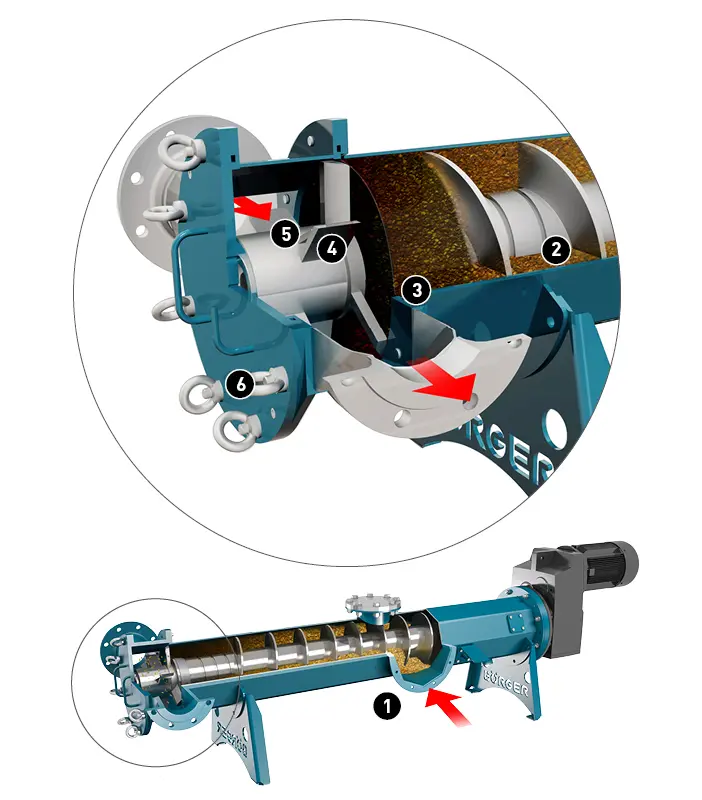
| 1 | Receiving hopper | Biomass is fed in through the receiving hopper mounted on the Powerfeed. |
| 2 | Press channel | At the end of the press channel the biomass is compressed. The length of the plugs can be adapted individually to the type of medium. |
| 3 | Screw shaft | The rotating screw shaft is made of particularly hard-wearing stainless steel. It is connected to a parallel-shaft helical geared motor through the drive shaft. The other end of the screw shaft carries the rotating compression and feed unit and is supported in a counter-bearing with a quick-release cover. |
| 4 | Flushing unit | Recirculating liquid flows through the flushing unit, where the biomass is distributed. The flow direction is reversible. |
| 5 | Central clamping device | A central screw secures the mixer blade, the scraper blades and the adjustable screw adapter that forms the plugs. |
| 6 | Quick-release cover | The quick-release cover gives fast access to the internal mechanism of the Powerfeed unit. The pressing process is adjusted through the quick-release cover. |
The advantages of the Powerfeed mechanical feeding unit at a glance
The Börger Powerfeed stands out for its extremely efficient and economical operating principle and, in particular, for versatile characteristics that can be adapted to individual requirements.
| ✓ | A closed system with no odour and no gas leakage | The Powerfeed is a closed system and operates without unpleasant odour. Gas leakage is ruled out. |
| ✓ | Less entrained air | The substrate is affected by the position and type of pressing unit in the Powerfeed and by the design of the blade and the doser. As a result the substrate gains a large surface area and entrained air is removed. |
| ✓ | Less mixing in the tank | Precise dosing of solid substrate by a self-contained feeding unit reduces mixing costs. |
| ✓ | Lower electricity consumption | Less mixing in the tank saves electricity |
| ✓ | A dosing system for any number of tanks and tanks of different sizes | The Powerfeed is extremely versatile and can be used in almost any biogas system. |
| ✓ | Few moving parts, a simple and compact drive unit | This simple but effective system has very few moving parts, which reduces wear on the equipment. |