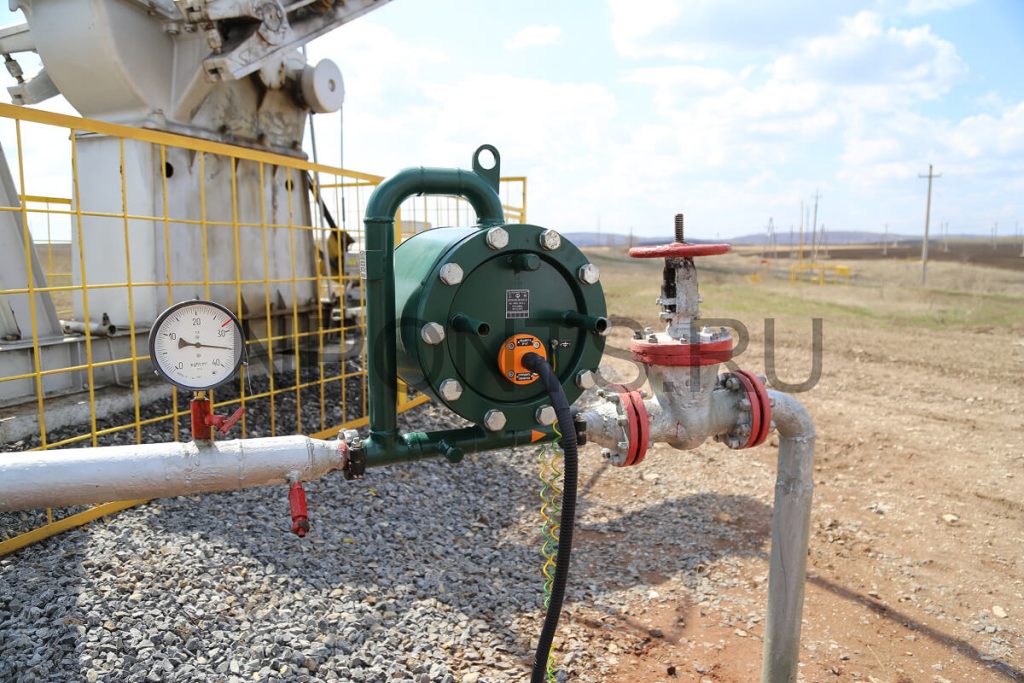
The SKZh liquid flow meter measures the mass flow rate and total quantity of liquid in a stream of oil-gas-water mixture. It is used at oil production and chemical industry facilities and at units for the operational monitoring and metering of oil production.
The SKZh meter measures the parameters of crude oil and other process liquids without first separating the stream. The device monitors the flow of the medium under both steady and variable operating conditions of the pipeline system.
Purpose of the SKZh liquid meter
The main purpose of the instrument is to measure the mass and flow rate of liquid in process pipelines. The meter is used at oil wellheads, at well production metering units and in process control systems.
The instrument can measure a variety of liquids, including solutions with solid particles, petroleum products and other process media.
Areas of application
- oil production industry
- oil production metering units
- chemical industry
- mixing and batching processes
- monitoring of liquid media flows
The meter can be used in hazardous areas of industrial facilities provided the requirements of regulatory documents and equipment operating standards are observed.
How the meter works
The meter works by measuring the mass of liquid in a stream of oil-gas-water mixture. The oil and gas mixture enters the measuring chamber of the instrument, where the gas and liquid phases separate.
Free gas fills the transducer housing, creating a gas environment of lower density. This makes it possible to measure the mass of the liquid in a gas atmosphere. When the measuring chamber fills, the liquid is discharged into the pipeline and the measurement cycle repeats.
Signals from the sensors are sent to the computing unit, where the data is processed and the flow rate and mass of liquid are calculated.
Key advantages
- flow measurement without prior separation of the oil and gas stream
- operation at both steady and variable flow rates
- high measurement accuracy
- use in hazardous areas
- reliable operation in oil production conditions
Use in the oil and gas industry
SKZh liquid meters are widely used at oil fields to monitor oil production and meter well output. Using this equipment improves the accuracy of production accounting and gives better control over process operations.
Oil-gas-water mixture
| Parameter | Value |
| Working (nominal) pressure, MPa (kgf/cm2) | 4.0 and 6.3 (40 and 63) |
| Temperature, standard version, °C | from 0 to 70 |
| Temperature, high-temperature version “V”, °C | from 0 to plus 120 |
| Temperature, corrosion-resistant versions “K”, “KO”, “KOR”, °C | from 0 to plus 100 |
| Density, kg/m3 | from 500 to 1500 |
| Upper kinematic viscosity limit (depending on the version), m2/s | 1,5·10-4 5·10-4 10·10-4 |
| Permissible content (volume fraction) of free petroleum gas in the oil-gas-water mixture under measurement conditions, % | determined by the measurement procedure (MVI) |
| Hydrogen sulphide content in free petroleum gas by volume, at pressures up to 1.83 MPa (18.3 kgf/cm2), % | 4 |
| Hydrogen sulphide content in free petroleum gas by volume, at pressures above 1.83 MPa (18.3 kgf/cm2) up to the maximum working pressure, % | 1 |
Ambient conditions
| Parameter | Value |
| Air temperature, meter in standard climatic version, °C | from −40 to +50 |
| Air temperature, meter in northern climatic version “S”, °C | from −50 to +50 |
| Relative air humidity, meter in standard climatic version, transducer | 100% at T=25 °C with moisture condensation |
| Relative air humidity, meter in standard climatic version, BESKZh-2M13 computing unit | 80% at T=35 °C without moisture condensation |
| Relative air humidity, meter in standard climatic version, BESKZh-2M17 computing unit, explosion-proof computing units | 100% at T=35 °C with moisture condensation |
| Relative air humidity, meter in northern climatic version “S”, transducer | 95% at T=35 °C with moisture condensation |
| Relative air humidity, meter in northern climatic version “S”, computing unit | 95% at T=35 °C without moisture condensation |
Frequently asked questions
What is an SKZh and what is it for?
SKZh stands for liquid quantity meter. It measures the volume of the oil-gas-water mixture coming from oil wells. It is used on automated group metering units (AGZU) for the day-to-day metering of production from each well.
What does the abbreviation SKZh stand for?
SKZh stands for “liquid quantity meter”. In the oil industry this is the standard designation for instruments that meter oil-gas-water mixture at wells and metering units.
What is the operating principle of the SKZh meter?
The operating principle is based on measuring the mass of liquid in a stream of oil-gas-water mixture. The mixture enters the measuring chamber, where gas and liquid separate. Free gas fills the transducer housing, which allows the mass of the liquid phase to be measured accurately. When the chamber fills, the liquid is discharged into the pipeline and the measurement cycle repeats.
At what gas content does the SKZh work correctly?
The optimum free gas content in the measured medium is 2 to 50 per cent. Above that, measurement accuracy falls. That is why, as part of an AGZU, an SKZh meter always works together with a separator.
How often is an SKZh calibrated?
Calibration is carried out once a year in line with the established calibration interval. Operating an instrument whose calibration has expired breaches the requirements for the commercial metering of hydrocarbons.
What documents are included with an SKZh?
The delivery set includes: the meter passport with serial number and technical data, the calibration certificate, the operating manual and a logbook for maintenance records.
Where can I read more about the design and use of the SKZh?
Read more in our articles: Design and operating principle of the SKZh liquid meter and SKZh: what it stands for and how it is used in the oil industry.
The SKZh liquid meter — what it is and why it is needed
The SKZh liquid meter is a volumetric measuring instrument for metering oil-gas-water mixture at the wellhead and within automated group metering units (AGZU). Unlike an ordinary liquid meter for water or fuel, the SKZh works with a multiphase medium containing oil, gas, formation water and mechanical impurities at the same time. Its design accounts for the physics of gas and liquid separation in the measuring chamber.
At oil and gas facilities in Kazakhstan, SKZh liquid meters are the primary instrument for metering production from each well. All produced fluid passes through them before entering the gathering pipeline. Commercial oil accounting and the allocation of shares between producing companies depend on their accuracy.