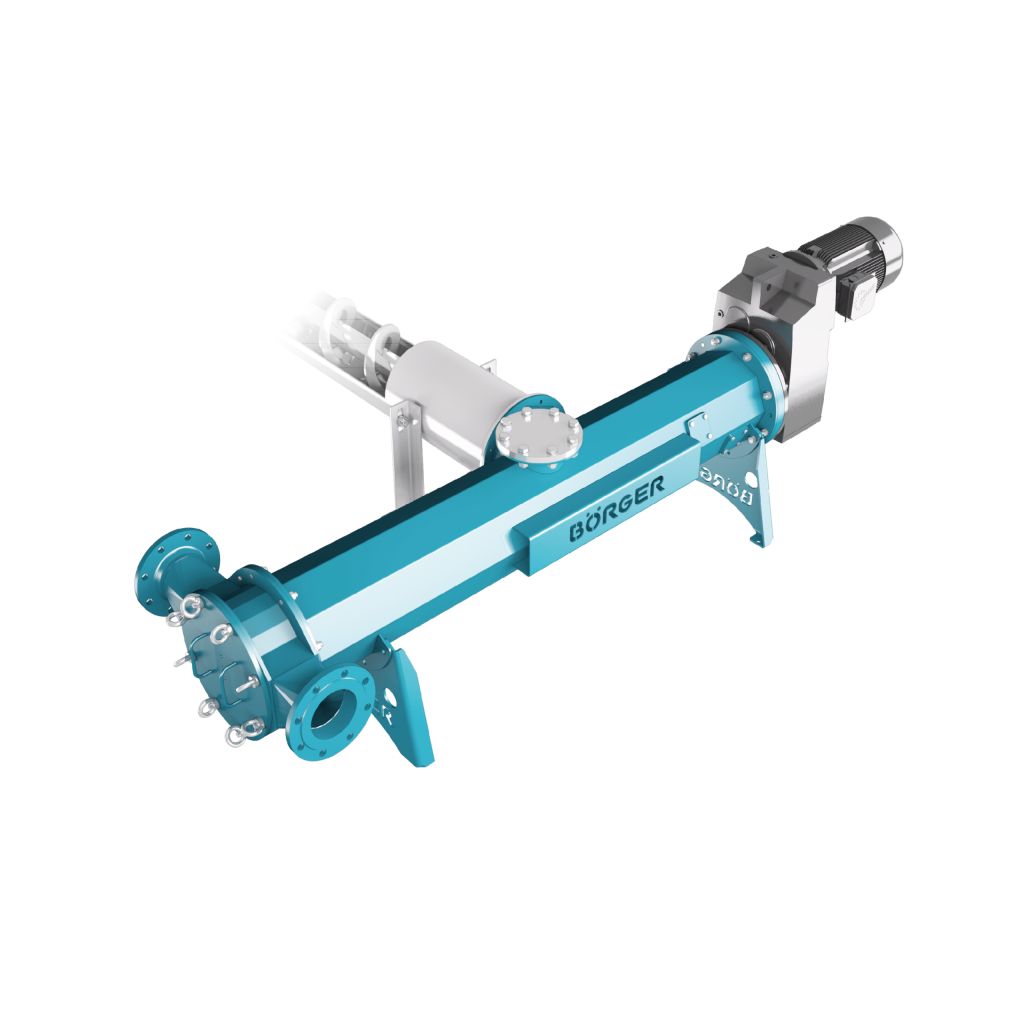
Powerfeed is Börger’s solid biomass feeding unit for biogas plants. It takes silage, manure, food-processing waste and other dense feedstock, mixes it with the liquid fraction and delivers the resulting slurry to the digester. The evenness of gas production across the whole plant depends directly on how steadily this unit works.
What problem it solves
Solid feedstock cannot simply be tipped into a digester: the biological process needs substrate to arrive evenly. Sharp swings in loading upset the microflora and gas yield falls.
The second problem is transport itself. Dense biomass with fibrous content tends to form plugs and stick to walls, which is why screw systems stop regularly for cleaning.
Powerfeed solves both: the feedstock is pre-mixed with liquid fraction from the digester and delivered as a homogeneous, pumpable slurry.
How it works
- Solid biomass enters the receiving hopper from the loading system.
- Liquid fraction — usually recirculate from the digester — is fed into the mixing chamber.
- The components are mixed into a homogeneous slurry of the set consistency.
- A rotary lobe pump delivers the finished mixture to the digester.
Using recirculate instead of fresh water saves resources and preserves the digester’s heat balance — the substrate arrives already warmed.
Model range
| Model | Capacity | Areas of application |
|---|---|---|
| Powerfeed 300 | 4–5 t/h | Small and medium-capacity plants |
| Powerfeed 400 | up to 9 t/h | Large plants, high-density feedstock |
The model is selected according to the digester’s daily substrate requirement with a margin for peak loads. Undersizing means the unit runs continuously at its limit, which shortens its life.
Design features
- Servicing without dismantling. Access to the working parts is through a removable cover — the pipework and drive stay in place.
- Replaceable wear parts. Parts in contact with abrasive feedstock are made replaceable, so the whole unit does not have to be changed.
- Protection against foreign objects. Stones, metal and other objects arriving with the feedstock are trapped before they reach the pump end.
- Adjustable consistency. The ratio of solid to liquid fraction is set to suit the particular feedstock.
What this means in practice
Even substrate feeding stabilises the biological process: gas yield becomes predictable and the risk of digester acidification falls. There are fewer unplanned stops to clear plugs, and servicing takes less time because the components can be reached without dismantling the pipework.
What to read next
- Powerfeed — product page
- Bioselect RC — the separator for splitting phases at the digester outlet
- Börger rotary lobe pumps: design and operating principle
- How to avoid pump blockages in industry
To select a model for your plant’s parameters get in touch.