
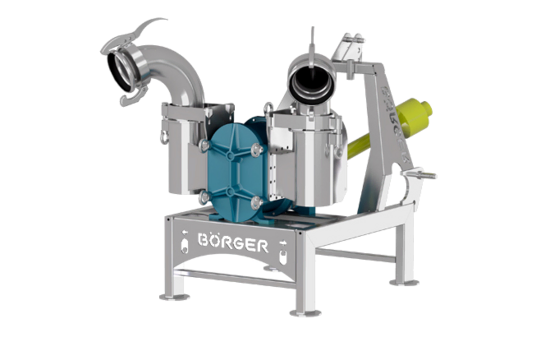
Börger builds rotary lobe pumps in several versions — from fixed installations for production lines to portable units and firefighting modules. The pump end stays the same in each case: what differs is the mounting, the drive and the pipework. Those are what determine whether a particular version suits your duty.
Below we go through all the available types and give a selection table by application scenario.
What determines the choice
Before selecting a version it is worth answering four questions:
- Does the pump stay in one place or move around? This determines the choice between a fixed frame and a mobile chassis.
- Is power of the required rating available at the site? If not, a unit with a diesel or PTO drive is needed.
- How abrasive and viscous is the medium? The rotary lobe design copes with contaminated and viscous media, but where the solids content is high a grinder is installed upstream of the pump.
- How often is servicing required? The Maintenance in Place design allows the pump to be serviced without dismantling the pipework — critical where the work schedule is tight.
Fixed installations
Suitable for permanent process lines where the pump stays in one place and is connected to fixed pipework.
Three-Point Base-Mounted Unit
The basic fixed version. A three-point base compensates for an uneven floor and reduces vibration transmitted to the foundation — the unit can be installed without major site preparation.
More about the base-mounted unit →
Container filling systems
A ready-made unit for filling and emptying tanks. Supplied with shut-off valves and pipework components, which reduces the amount of design work at installation.
Pumps on vehicles
Tanker-Mounted Pump
Mounted directly on a vacuum or transport tanker and driven from the vehicle’s engine via a PTO shaft. No separate power source is needed — the pump works wherever the vehicle can reach.
Typical applications: removing liquid waste, pumping manure slurry, servicing remote sites without mains power.
More about the tanker-mounted pump →
Mobile versions
Needed where the pumping point changes: emergency work, servicing several tanks, seasonal duties.
Mobile Pumping Unit
The highest-capacity mobile solution. Pump, drive and pipework are assembled on a common frame or trailer, which allows the whole package to be moved between sites without dismantling.
Portable Pumps
A compact version for work in confined spaces — pits, basements and service galleries where a vehicle cannot go.
Hand-Trolley Pump
An intermediate option between portable and mobile. The trolley allows one operator to move the pump around the site while keeping the capacity of a full-size unit.
More about the trolley-mounted pump →
THW Pump
A version for civil protection services and emergency response teams. Designed for rapid deployment and for handling contaminated media — flood water, effluent and media with solids.
Special purpose
Fire Pump
A module for delivering large volumes of water during firefighting and post-flood pumping. The rotary lobe design keeps working on contaminated water, which quickly destroys centrifugal pumps.
Selection table
| Duty | Recommended version |
|---|---|
| Continuous pumping in a process line | Three-Point Base-Mounted Unit |
| Filling and emptying tanks | Container filling systems |
| Removing liquid waste, field work | Tanker-mounted pump |
| Servicing several sites | Mobile Pumping Unit |
| Work in pits and confined spaces | Portable Pumps |
| Moving around the site by one operator | Hand-Trolley Pump |
| Emergency response work | THW Pump |
| Firefighting, post-flood pumping | Fire Pump |
What to consider when ordering
The version is only part of the solution. Correct selection requires: the capacity and head needed, the properties of the medium (viscosity, solids content and particle size, abrasiveness, temperature), the drive type available and the installation conditions.
If the medium contains large solids, a grinder is usually installed together with the pump — this reduces the risk of blockages and extends the life of the working parts.
What to read next
- Börger rotary lobe pumps: design and operating principle — how the pump end, common to all versions, is built
- How to avoid pump blockages in industry — what to do with media containing solids
- How the Börger industrial grinder works — the operating principle of the pump protection unit
To select a specific model for your parameters get in touch — we will size the version and prepare a quotation.