
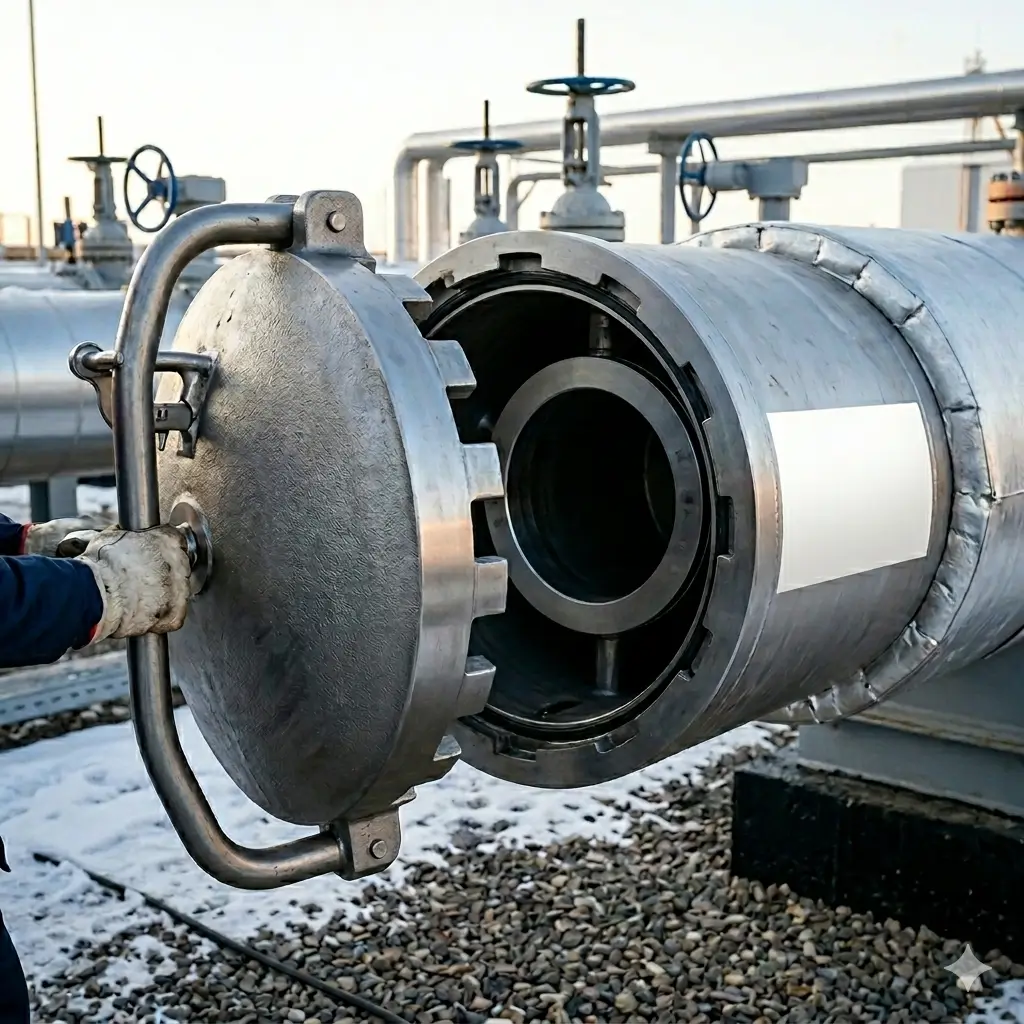
A bayonet end closure is an industrial closure device for sealing the ends of pressure vessels, filters, heat exchangers and other pipeline components. The bayonet connection allows quick opening and closing without threaded fasteners, which considerably shortens the time needed for equipment maintenance operations.
Purpose
The closure provides quick access to the internal cavity of vessels that need regular servicing — cleaning filters, replacing internal parts, inspecting heat transfer surfaces. It is used in systems with aggressive media, under high pressure and wherever reliable sealing is required.
Design and operating principle
The closure is based on the bayonet principle — the cover is fitted to the body with a turn that brings its lugs behind the locking segments of the body. Sealing is provided by a rubber or PTFE ring between the cover and the body flange.
To open it, the system pressure must be released, the cover turned through a set angle and lifted off the body. The procedure takes a few minutes and needs no special tools.
Technical specifications
| Nominal diameter (DN) | from 80 to 500 mm |
| Working pressure | up to 16 MPa |
| Process medium temperature | from −40 to +200 °C |
| Body material | carbon or stainless steel |
| Seal material | NBR, EPDM, FKM, PTFE |
| Connection type | flanged |
| Climatic version | UKhL1 |
Areas of application
Oil and gas — fitted to strainers, separators and heat exchangers at production facilities and oil treatment units.
Chemical industry — sealing vessels with aggressive media, reactors and filters on process lines.
Power generation — closing the ends of heat exchange equipment, steam filters and water treatment units.
Water treatment — sealing coarse and fine water filters at industrial facilities.
Advantages of bayonet closures
- Quick opening and closing — the operation takes minutes instead of the hours needed for flanged connections
- No threaded fasteners — reduces the risk of seizing and makes servicing easier
- Reliable sealing — a rubber or PTFE seal withstands high pressures and aggressive media
- Long service life — with the right materials the closure lasts up to 20 years
- Simple servicing — the seal is replaced without dismantling the body
Frequently asked questions
How does a bayonet closure differ from an ordinary flanged cover?
A bayonet closure opens with a turn, without undoing fasteners, which is 5–10 times faster. A flanged cover requires every bolt to be undone in turn and the cover lifted off.
Can a bayonet closure be used at high pressure?
Yes. The standard design is rated for pressures up to 16 MPa. Special versions are made for higher pressures.
How often does the seal need replacing?
Depending on the medium and how often it is opened — every 1 to 5 years. Replacement is done on site without dismantling the closure.
Asia Supply supplies bayonet closures to Kazakhstan to the customer’s technical requirements. Contact our specialists for a quotation.