
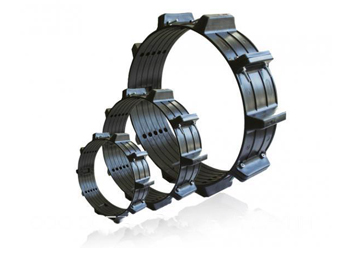
Spacer rings are used in the construction and laying of pipeline systems to position pipes correctly inside protective casings and casing structures. They prevent the pipeline from touching the inner surfaces of the casing pipe and ensure that loads are distributed evenly.
Spacers are used when laying trunk pipelines, utility lines and process lines at industrial facilities. Using them increases the reliability of the pipeline infrastructure and reduces the risk of mechanical damage to the pipes.
Purpose of spacer rings
The main task of spacers is to keep the pipeline correctly positioned inside the protective casing and to prevent damage to the pipe's insulating coating. With them the pipeline stays stable and is protected from external effects.
Benefits
- protection of the pipeline from mechanical damage
- even distribution of the load on the pipeline
- prevention of contact between the pipe and the casing
- longer service life of the pipeline system
- greater reliability of the utility infrastructure
Areas of application
Spacer rings are used in the construction of trunk pipelines and when laying pipes under roads, railway tracks and utility lines.
Spacers are also used at oil and gas, power and industrial facilities where reliable protection of pipeline systems is required.
Materials
Spacer rings are made of durable materials resistant to environmental effects. Their design ensures secure fixing of the pipe and resistance to mechanical loads.
Modern materials allow spacers to be used in a variety of climatic conditions and on pipelines carrying different process media.
Use in pipeline systems
Spacers are an important part of pipeline infrastructure. They allow pipelines to be laid safely and protect the pipe insulation from damage during installation and service.
Types and designs of spacer rings
Spacer rings are produced in several basic designs. Belt spacers are a one-piece structure with support elements around the perimeter, rated for heavy loads and long service life. Split spacers made of two half-rings with a locking joint are fitted onto an assembled pipeline without cutting the line. Narrow monobloc versions are used on short crossings under roads and utility lines.
The support elements (runners) are made of wear-resistant polymer, nylon or composite material. Their height is selected so that a guaranteed clearance of 10 to 50 mm remains between the pipe and the wall of the protective casing, depending on installation conditions.
Size range and selection by diameter
A spacer is selected by two parameters: the outside diameter of the carrier pipe and the inside diameter of the protective casing. The standard range covers carrier pipe diameters from 57 to 1420 mm. For non-standard diameters, custom spacers are made to the customer's drawing.
Selection also takes into account the pipe insulation material — for pipes with PUF insulation, spacers with extended supports are used so as not to disturb the structure of the insulating coating.
Installation details
Spacers are installed at intervals of 1–3 metres depending on the pipe diameter and pulling conditions. Before the pipeline is pulled into the protective casing, the spacers are fixed to the pipe with bolted clamps or locking joints. After installation they remain inside the casing for the whole service life of the pipeline.
For horizontal directional drilling (HDD), reinforced spacers with additional support points are used, rated for the higher shear loads that occur during pulling.
Related products
To complete pipeline systems we also supply pipeline fittings — elbows, reducers, flanges — and pipeline valves and fittings: ball valves, gate valves, check valves.
Asia Supply — supply of spacer rings and pipeline components in Kazakhstan. Selection of the size range to match the project design. Catalogue — “Asia Supply”.
Spacer ring — purpose and installation principle
A spacer ring is a centring element that holds the carrier pipe inside the protective casing during trenchless pipeline laying. Each spacer ring grips the carrier pipe with clamps and rests against the inner surface of the casing on wear-resistant runners. Unlike wooden pads and improvised props, a metal-and-polymer spacer ring does not break down over long service and does not damage the pipe insulation during pulling.
At industrial sites in Kazakhstan and the CIS, spacer rings are used when laying oil and gas pipelines under roads and railway tracks, where trunk pipelines cross utility networks, and in horizontal directional drilling (HDD). The rings are installed at intervals of 1 to 3 metres depending on pipe diameter and loads.